
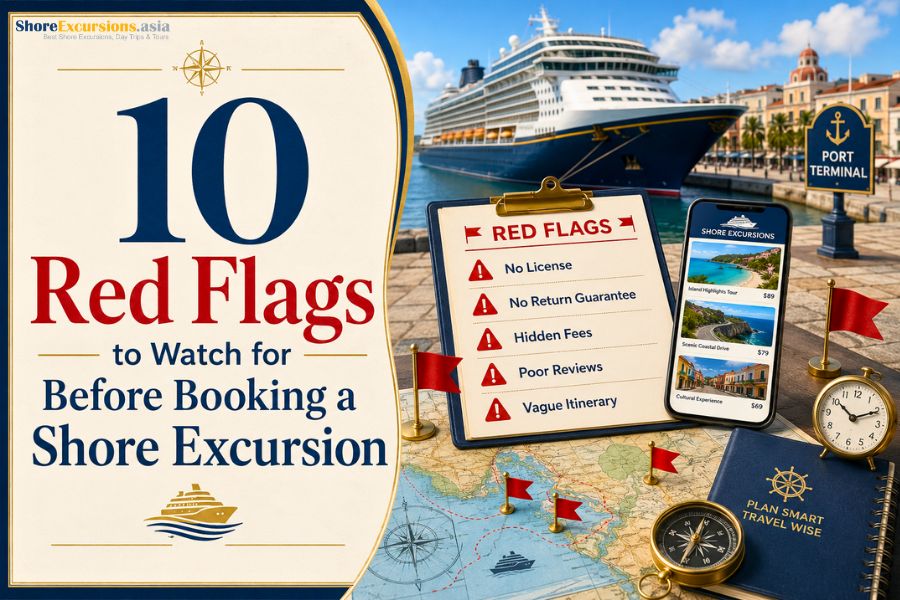
Booking an independent shore excursion can give cruise passengers more choice, smaller groups and greater flexibility ashore. But not every tour advertised online is designed with cruise passengers in mind.
At Shore Excursions Asia, we believe the most important questions should be answered before you ever leave the ship. Who is actually operating your tour? Where will your guide meet you? How much time has been allowed for the return drive? And what happens if something changes on the day?
A beautiful itinerary and a low price can be appealing, but neither tells you if the operator understands the realities of a cruise port day. Before you book, look for these 10 red flags.
1. They Do Not Ask for Your Cruise Ship and Port Schedule
A shore excursion operator should know more than the city you want to visit.
Your ship name, port, arrival date and departure time determine how the entire day needs to be planned. Without this information, it is difficult to calculate a realistic pickup time, sightseeing window and safe return to the terminal.
If an operator is ready to confirm your excursion without asking which ship you are sailing on, that should raise questions.
A Shore Excursion Is Not the Same as a Regular Day Tour
A standard city tour may begin at a hotel at 8:00 am and finish whenever the itinerary is complete. A cruise excursion works within a fixed port call.
The guide and operations team need to understand when passengers can realistically leave the ship and when the vehicle should begin returning to port.
This becomes particularly important in destinations where the major sights are far from the cruise terminal.
2. They Cannot Clearly Explain Who Is Operating Your Tour

It is common in travel for one company to sell a tour and another local company to operate it. That arrangement is not automatically a problem. Destination Management Companies, often called DMCs, play an important role in coordinating local guides, vehicles and services.
The red flag is a lack of transparency.
If you ask who will operate your excursion and receive a vague answer, or if the seller cannot explain who is responsible locally, you may have difficulty knowing who to contact if something goes wrong.
Look Beyond the Website You Book Through
A professional booking page does not necessarily mean the same company will meet you at the port.
Ask who provides the guide, vehicle and local operations. A reliable company should be able to explain how its destination partners are selected and who remains responsible for your booking.
This is especially important when several layers of resellers and subcontractors are involved.
3. There Is No Clear Information About Licensed Guides

A knowledgeable local guide can completely change the quality of a shore excursion.
Guide requirements vary between destinations, but where professional or government licensing applies, the operator should be able to explain the qualifications of the guide assigned to your tour.
Be cautious when the description uses only vague phrases such as “local person,” “English assistant” or “friendly driver” when you are expecting a professionally guided sightseeing tour.
A Driver and a Guide Are Not Always the Same Service
A private car with an English-speaking driver may be perfectly suitable if transportation is all you need. It is different from booking a guided cultural or historical excursion.
Before paying, make sure you know exactly what is included.
At Shore Excursions Asia, our tour information identifies guide service clearly, and our local guides are selected for destination knowledge, English communication and professional guiding experience.
4. The Port Pickup Instructions Are Vague

“We will meet you at the port” is not enough. Cruise terminals can be large, and access rules differ from port to port. Some guides can meet passengers immediately outside the terminal. At other ports, vehicles or independent guides may need to wait at a designated gate or pickup area.
You should know where you are going before you step off the ship.
Ask What Happens If You Cannot Find the Guide
A reliable operator should provide a clear meeting point, guide identification and a contact method for the day of the excursion.
Ideally, you should also know what to do if disembarkation takes longer than expected.
A serious red flag is an operator that provides only a general company email address and no practical way to reach the local team when you are standing at the terminal.
5. There Is No Plan for a Port Pickup No-Show
A port pickup is one of the most important moments of an independent shore excursion.
If your guide or vehicle does not appear, every minute spent trying to solve the problem reduces the amount of time available ashore.
Before booking, consider how the operator would handle a guide becoming ill, a vehicle problem or another operational disruption.
Reliable Operators Need More Than One Person Behind the Tour
A single freelance contact may provide an excellent experience, but it also creates a single point of failure.
A properly managed shore excursion normally has operational support behind the guide. If a vehicle develops a problem or a guide becomes unavailable, someone should be able to arrange an alternative rather than leaving passengers to solve the situation themselves.
You do not need to ask for every operational detail, but the operator should be able to explain how support is provided when plans change.
6. The Itinerary Looks Good but the Timing Does Not Add Up
This is one of the biggest red flags in a shore excursion proposal.
An itinerary may contain every famous attraction in the destination and still be a poor choice for cruise passengers.
Look at how far the port is from the sightseeing area, how much driving is required between attractions and how much time is actually available at each stop.
Be Careful With Unrealistically Full Itineraries
If one operator promises seven attractions while every comparable excursion includes four or five, ask how those extra stops fit into the same port time.
They may simply be brief photo stops. More concerningly, the itinerary may have been copied from a normal land tour without accounting for cruise terminal transfers and return timing.
A realistic itinerary is more valuable than an impressive list of places that cannot comfortably be visited.
If you are still deciding how much is reasonable in one day, our guide to common cruise port day mistakes explains why usable sightseeing time is usually shorter than the full port call shown on your cruise itinerary.
7. They Cannot Explain Their Return-to-Ship Plan
“Don't worry, we'll get you back” is not a return plan.
A cruise-focused operator should be able to explain approximately when the sightseeing portion ends, how long the return transfer normally takes and how much additional time is being allowed before the ship departs.
This is especially important when the destination is a long drive from the port.
Ask About the Buffer, Not Just the Tour End Time
A tour that finishes at 4:00 pm tells you very little unless you also know when your ship departs and where the tour finishes.
The safest itinerary is built backwards from the required port return time.
Shore Excursions Asia publishes a Back-to-Ship Guarantee and missed departure policy, with our port-day schedules planned around a return buffer before the ship's scheduled departure.
If an independent operator has no clear policy or cannot explain how return timing is managed, think carefully before booking.
8. Their Cancellation and Missed-Port Policy Is Unclear
Cruise itineraries can change. Weather, port conditions or operational decisions may cause a ship to arrive late, alter its schedule or skip a port completely.
Before booking an independent excursion, find out what happens to your payment if the ship does not call at the port.
The policy should be available before you pay, not something you discover after a cancellation occurs.
Look for Cruise-Specific Terms
A general cancellation policy written for hotel guests may not address the situations cruise passengers actually face.
Check how the operator handles a missed port, changed arrival time or major alteration to the ship schedule.
Also look at how quickly you need to inform the operator if your cruise line changes the itinerary.
9. The Price Is Much Lower but Nobody Can Explain Why
Independent shore excursions can often offer strong value, particularly when the group is small or traveling privately. A lower price alone is not a red flag.
An unexplained price difference can be.
When comparing excursions, check the guide, vehicle, entrance fees, meals, port pickup, group size and tour duration rather than looking only at the headline figure.
Know What Has Been Removed to Reach the Lower Price
One tour may include a licensed guide and private vehicle while another provides only transportation. Entrance tickets may be included in one proposal and paid locally in another.
A very cheap excursion may also rely on a much larger group or use a meeting point outside the port that requires passengers to arrange additional transportation themselves.
The best value is the tour whose inclusions and responsibilities are clear before you book.
10. Your DIY Plan Has No Backup Option
Planning your own port day can be enjoyable, and many cruise ports are easy to explore independently.
The red flag is a plan that works only if every connection happens perfectly.
If your day requires a local bus, two trains, timed attraction tickets and another train back to the cruise terminal, consider what happens if one part of the plan is delayed.
Do Not Confuse Possible With Comfortable
A route may technically be possible according to an online timetable but still leave very little margin for error.
This is particularly important when traveling far from the port or visiting a destination where transportation is unfamiliar.
Ask yourself how you would return if a train were missed, a taxi were unavailable or an attraction took longer than expected.
If the answer is unclear, an organized excursion may be the better choice for that particular port.
What Should a Trustworthy Shore Excursion Operator Show You?
You should not need to investigate a tour company like a detective.
A reliable operator should make the important information reasonably easy to find. You should know who you are booking with, what the tour includes, how the guide and vehicle are arranged, where you will meet, how the itinerary fits your port time and what happens if the cruise schedule changes.
Look for an established business identity, real contact information and a visible history of traveler feedback. Licensing or business credentials should be available where applicable, and cancellation terms should be written clearly.
Most importantly, the company should understand cruise logistics rather than simply selling a city tour to someone who happens to arrive by ship.
Good Questions to Ask Before You Pay
You do not need to send an operator a long questionnaire. A few clear questions often reveal a great deal.
Ask where the guide will meet you, if the tour is planned specifically around your ship, who operates the tour locally, what guide service is included, when the return to port is planned and what happens if the ship misses the port.
The quality and clarity of the answers can be just as useful as the answers themselves.
Independent Shore Excursions Are Not the Red Flag
There is an important distinction to make.
Booking independently from the cruise line is not in itself risky or irresponsible. Reputable independent operators serve cruise passengers around the world and can provide smaller groups, flexible itineraries and more personalized sightseeing.
The risk comes from booking without knowing who is responsible for your day ashore.
If you are deciding between the two options, read our guide to cruise line vs independent shore excursions before choosing.
The right independent operator should make you feel more informed before you book, not less.
What We Look for When Planning a Shore Excursion
At Shore Excursions Asia, port-day planning begins with the cruise schedule.
We look at the ship, port, arrival and departure time before building the sightseeing route. The itinerary is then matched with local guide service, suitable transportation and a return schedule designed around the ship rather than a standard city-tour timetable.
Our website also displays information such as walking level, guide type, departure port and Back-to-Ship planning on many of our shore excursions so passengers can understand the day before confirming it.
If you cannot find an existing excursion that matches your schedule or interests, you can design a private shore excursion with our team around your ship, preferred pace and port time.
A Good Shore Excursion Should Give You Confidence Before the Port Day
The best time to discover a problem with an operator is before you have paid, not after you walk off the ship.
Look beyond attractive photographs and a long list of attractions. Check who operates the tour, who guides it, where the meeting point is, how the timing works and what protection exists if the cruise schedule changes.
There is nothing wrong with booking an independent shore excursion or planning a port independently. The important thing is understanding where the responsibility sits and having enough margin when something does not go exactly as planned.
Your time ashore is limited. The company you trust with it should be able to show that they understand that from the beginning.


 Send Inquiry